
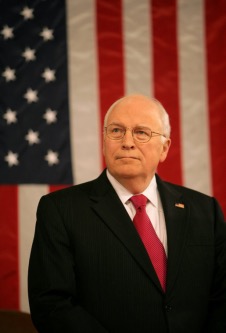
Image courtesy of White House Archives
The Power Player: A Look at the Life of Dick Cheney
| published November 5, 2025 |
By R. Alan Clanton, Thursday Review editor
More than any other politician or policy-maker, his influence was the most significant in the post-9/11 era, and much of his legacy remains at the center of security and foreign policy debates even now, a quarter of a century after al Qaeda’s infamous attacks on New York and Washington.
Dick Cheney, who served as vice-President under George W. Bush, and in a variety of influential roles throughout the administrations of Richard Nixon, Gerald Ford, Ronald Reagan and George H.W. Bush, has died at age 84. Cheney had long suffered from a variety of heart-related and cardiovascular problems. His first serious heart attack came at age 37, and throughout his life Cheney had been hospitalized at least a dozen times for heart issues.
Among his places in the history books, Cheney may be best remembered for how he redefined the job of vice-President, elevating the role from that of a prince-in-waiting with largely ceremonial duties, to that of a driver and influencer. Indeed, after 9/11 Dick Cheney—a skilled power-player with few Washington rivals—became arguably the most proactive vice-President in U.S. history, quietly shaping White House policy on a variety of key issues.
Cheney is largely regarded by history as the chief architect of American foreign policy and homeland security in the 21st century, the clear-eyed pragmatist—some would argue cold-eyed—who in effect ushered-in most of what became the New Normal in the world after the terror attacks of September 11, 2001. After 9/11, Cheney, working with his closest allies within the administration of George W. Bush, argued forcefully for the implementation of an aggressive approach to the threat of global terror—a strategy which became controversial for its uses of overt force against nations which foster or offer safe havens for terror, and for his advocacy of use of harsh interrogation techniques on detainees and suspected terrorist.
Expressed both sometimes publicly and often to his colleagues throughout the early half of his career, Cheney also advocated strongly for a reassertion of governing strength by the White House and by Presidents. Cheney had witnessed—largely from the inside—the slow erosion of executive power in the post-Vietnam and post-Watergate era, and during his stint in the administrations of Ronald Reagan and George H.W. Bush, Cheney pressed his belief that policy should be made by Presidents and that too much power had been shunted aside to Congress and to the courts.
By the time he was selected by George W. Bush to serve as his running-mate in 2000, Cheney had become a practitioner of neo-conservative values and a staunch globalist in the truest sense.
A Yale attendee who dropped out of college, and a late-arriver to politics, Richard Bruce Cheney had worked in the oil and gas industry as a young man, then in 1969, through what would become a trademark combination of persistence and careful angling, he landed an internship with Wisconsin Congressman William A. Steiger, a Republican. Through his work in Steiger’s office in the early Nixon years, Cheney met his new mentor, a young Donald Rumsfeld. Rumsfeld had been recently appointed director of the Office of Economic Development. In late 1969, after only about eight months on Steiger’s staff, Cheney went to work for Rumsfeld.
Soon thereafter, hitched to Rumsfeld’s steadily rising star, the two moved their way closer within the White House circles. By 1971, Cheney had become a White House assistant and acted in numerous roles within the administration, including serving as assistant director for the Cost of Living Council in the Nixon years. Then, the steady damages of Watergate worked their way to the top, though Cheney and his friend Rumsfeld were untouched by the scandal as they had remained—by their own design or by a fluke of history—disconnected from its machinations. Nixon resigned the presidency in August 1974.
In the rapid power vacuum created by resignations and convictions, Rumsfeld and Cheney moved more notches upward, and by 1974 Cheney had landed the job of Deputy Assistant to the President for Gerald Ford. As Ford sought to shore up his flanks with allies and those without Watergate baggage, Cheney eventually became deputy chief of staff—then, shortly afterwards—chief of staff, after Gerald Ford asked Rumsfeld to become his new Secretary of Defense. Cheney became the youngest person ever to hold the job of Chief of Staff.
When Ford lost the presidency to Democrat Jimmy Carter in 1976, Cheney decided to seek another path back into Washington circles, and in 1978 he ran a successful campaign to fill the congressional seat being vacated by the retiring Democrat Teno Roncalio in Wyoming. Cheney would go on to get re-elected to his Wyoming seat five times, and would work tirelessly to keep his star on the rise within the Republican Party. Later, in the long and complex run-up to the Republican Convention in 1980, Cheney was an advocate for Ronald Reagan—this at a time when the field of GOP candidates still included George H.W. Bush, Bob Dole, Howard Baker, Phil Crane, and others. Cheney later told interviewers that he saw Reagan’s candidacy as a clear and decisive path forward for the GOP at that moment when the nation’s demographics were shifting and the country was perceived as moving to the right.
An effective negotiator and pragmatic deal-maker, Cheney would be elected in 1987 to serve as House Minority Whip—in effect the chief bargainer and cat-herder for the GOP in the House.
But Cheney’s star was again on the rise, and only a few months into his tenure as House Minority Whip, he got the call from the newly-elected President George H.W. Bush. Bush’s first nominee to fill the role Secretary of Defense, John Tower, had been roundly rejected by the U.S. Senate. Bush wanted Cheney. After Tower’s defeat, Cheney faced a much friendlier Senate, winning confirmation by an astounding 92-to-zero vote.
For Cheney, the job of Secretary of Defense would be his greatest game-changer. Cheney directed the Pentagon at the time of the U.S. invasion of Panama in late 1989, what was known as Operation Just Cause—a massive effort to curb the movement of illegal drugs from Panama into the U.S., to rid the Central American county of human rights violations and corruption, and to in effect oust strongman Manuel Noriega, who, despite having lost an election, was not willing to relinquish power. The other critical justification for the war was the protection of the various treaties signed and made legal during the administration of Jimmy Carter a decade earlier, when the United States relinquished control of the Panama Canal. Eventually, Noriega was brought to the U.S where he stood trial for money laundering and racketeering; he was also convicted of drug trafficking. Cheney had worked closely with President Bush and others at the White House during the engagement, and had also helped develop the overall justification, though the war ended with great long-term costs to Panama in the form of homelessness, unemployment, and infrastructure repairs.
Panama, as it turned out, was just a warm-up. In August of 1990 Saddam Hussein, President of Iraq, ordered a massive military invasion of the smaller neighboring nation of Kuwait. Iraqi troops rolled into Kuwait and quickly overran the entire country. Despite worldwide, and almost universal condemnation of the invasion and occupation, Saddam would not budge, and in fact ordered his commanders to fortify their positions around all of occupied Kuwait. Along with several United Nations’ resolutions, and a number of public and private communiques between the leaders of other Arab countries to Saddam, the United States itself offered to intervene at the direct behest of the leaders of Saudi Arabia, Qatar, Jordan, and other regional powers. Also, oil was at stake, vast quantities of oil which were the principal source of wealth for Kuwait, and as a direct result the economic interests of the United States and many of its closests allies and trading partners were at stake. By early January of 1991, Congress had authorized the President to use limitary force if needed to dislodge Iraqi forces from Kuwait.
What came next was Operation Desert Storm, the largest American military operation since the height of the Vietnam War decades before. Operation Desert Storm would become arguably the largest and most complex allied coalition of forces attempted since the end of World War II. In this, Cheney found his focus and his biggest challenge of his career to that date. Cheney oversaw the operations with a level of intense micro-management not seen since the days of Robert McNamara. General Colin Powell famously said of Cheney’s hands-on approach “he had become a glutton for information, with an appetite we could barely satisfy.”
Cheney—like General Powell and General Norman Schwarzkopf—also became a fixture, and by extension, an eventual star, of television, for in the days when only CNN offered the sort of 24-hour-a-day news coverage most Americans now take for granted, Cheney delivered an unprecedented number of press conferences to eager and hungry reporters, offering generally sober, restrained real-time assessments of the battle and of the strategic moves, even if what he said was limited or oblique. Though the air war took several weeks to carry out, the ground war was over with breathtaking speed: allied forces regained control of almost all of Kuwait within days, and after less than five days all Iraqi forces had been ejected (or had hastily retreated) from Kuwait. On Days Five and Six, the combined aviation forces of the U.S. Army, Marines, Navy and Air Force pounded what was left of the retreating Iraqi military, destroying hundreds of vehicles and tanks trapped along the narrow roads leading back toward Baghdad. The U.S. counted about 150 casualties from combat, and another 230 deaths from other causes. The majority of the deaths came from a single Scud missile attack on a large American barracks near Riyadh.
The success of Operation Desert Storm transcended the military objectives, the battlefield maps, and even the astonishing make-up of the otherwise unthinkable coalition. The Gulf War became a watershed for the U.S. for what many cited as its cleansing effect on the ghosts of Vietnam and its proof that the United States could still do large and great things.
In the aftermath of the war it appeared for a long season that with the soaring success of the Gulf War to his credit that then-President George H.W. Bush could do no wrong, and a second term seemed assured. Indeed, Cheney was still serving as Defense Secretary when—one after the other—some leading names among Democratic contenders stepped aside out of a reluctance to face an incumbent with such high approval numbers (Bush's approval ratings had, by that point, improbably exceeded even those of Reagan). But Bush lost in 1992 to former Arkansas Governor Bill Clinton, and Cheney's stint as Defense Secretary ended in January of 1993.
For the remainder of the decade, Cheney was content to fill a role as a director for the Council on Foreign Relations—his second term as director—a role which gave him not only direct access to the roundtable of policy thinkers and intellectuals who are members of the elite think tank, but also offered Cheney a visible place to express his own views on foreign policy in the post-Cold War era. Cheney remained a hawk—though cautious at times—even on the otherwise seemingly pivotal issues related to Eastern Europe, the collapse of Communism, and the break-up of the Soviet Union. Cheney was skeptical of potential resurgent Russia after the Marxist-Leninist crack-ups and the independence of so many former Soviet states, and indeed some of his largely contrarian views of that period now seem prescient, especially in the age of Putin and a war in Ukraine now in its third year.
The 1990s also brought Cheney business success when he was tapped to become CEO and chairman of the conglomerate Halliburton, though even this was not without controversy when accusations that company officials had inflated the value of certain aspects of Halliburton during a lengthy and complex merger negotiation with Dresser Industries. Several lawsuits ensued regarding Halliburton’s finances and business practices, though Cheney was not personally ever charged with a crime or called-out for wrongdoing.
At the end of the 1990s Cheney was approaching 60 and eyeing what would have been a comfortable retirement and the lucrative life of being an occasional speaker, policy talk show host, op-ed author, and maybe writer. Then, a funny thing happened on his way to retirement and the ability to look back a long and full life of public service: George W. Bush secured the requisite votes in the GOP primaries and caucuses and became, in effect, the presumptive Republican nominee. Bush needed a “wise old party man” to help usher the new administration in, and most especially to help develop a list list of potential running-mates for Bush. Cheney, still acting as CEO of Halliburton, was given the job or searching, reviewing and vetting the names. After many weeks or expanding the list, then, watching it contract, Cheney met with Bush privately and Bush suggested that Cheney himself take on the role.
Cheney made a clear-eyed and probably hyper-calculated decision: take on the role of Bush’s Veep. In books and films, this agreement between Bush and Cheney was not without some qualifiers set down by Cheney; among them, a proactive role in some of the heavy policy-making by the White House, and a clearly defined set of institutional areas of command. From the very beginning, Cheney wanted his place in the administration to contain far more than the usual symbolic and ceremonial roles.
While the famous election deadlock of 2000 played out—and while some of Bush’s top advisers were in encamped in Tallahassee and other Florida locations angling for every vote in every county—Cheney went to work, using private funding to support a small office and a staff in Washington, vetting names for many of the administration’s key positions. This would prove useful for Cheney later, as he was able to identify and hire some staff very much to his liking. Indeed, by the time the U.S. Supreme Court had put an end to the recounts in Florida, effectively delivering the presidency to George W. Bush and forcing Al Gore to concede, Cheney had stacked some of the key halls in the White House with talent in reliable agreement with his own positions and thinking.
Among them, his old mentor Donald Rumsfeld, for whom Cheney lobbied strongly for Secretary of Defense.
September 11, 2001 changed everything for everyone, including Cheney. President Bush was in Sarasota, Florida at the time of the World Trade Center attacks. Cheney was en route from his residence in Washington to the White House. Bush would receive his initial full scale briefing by phone in an empty classroom inside Emma E. Booker Elementary School. Cheney would watch the events in New York unfold on his television in his office at the White House, until it became necessary to evacuate him to a safer location.
Cheney’s role as a policy-maker would become forever inextricably connected to that post-9/11 world. It was Cheney who ordered that any plane for which there was certain confirmation of a hijacking be shot down by military aircraft before more ground-lives would be lost. It was Cheney who gave the go-ahead to enact the little-known—but already planned and rehearsed—SCATANA (Security Control of Air Traffic and Air Navigation Aids), which effectively stopped new aircraft from entering any U.S. airspace. It was Cheney who also clearly and decisively grounded all flights, and insisted that flights already in the air land as quickly and practicably as possible. Though for many weeks in the aftermath of 9/11, Cheney and Bush remained deliberately separated for security and safety reasons, Cheney’s fundamental role within the White House response grew day-by-day.
Most contemporary political historians and most of the inside accounts from those days suggest that Cheney’s influence grew in tandem with the new pressures upon the White House, and that Bush came to rely even more on Cheney’s shrewd if not hawkish views on the U.S. response. The War on Terror, as it came to be known, quickly grew in scope and complexity, and also arguably required the sort of soul-searching for which Cheney was impatient. In this instance, some of Cheney’s own direct appointees would serve as his back-ups, and his most effective facilitators—David Addington, Paul Wolfowitz, John Hannah, and Lewis “Scooter” Libby, Jr.
Though the pressure to halt worldwide terror and bring about retribution against al Qaeda and others involved in radical Islamic terror, Cheney may have been the person understood to be the most persistent driver of the U.S. policy mechanisms of the post-9/11 era. Cheney was then—and remained until his passing—an unapologetic believer in the reasons for the wars in Afghanistan and Iraq. In the case of the former, Cheney had little to prove: Afghanistan was at the time controlled by the Taliban, and the Taliban was providing a home and a safe haven for al Qaeda and other terror groups. In the latter case, Cheney was the leading voice that Saddam Hussein possessed weapons of mass destruction. This contention was debatable, and on this point some of the top people in the Bush White House disagreed sharply, and famously. As the divisions over Iraq and WMD grew more intense, Cheney used his considerable leverage to minimize the voices of dissent in the room, while making every effort to keep the pro-Iraq war talk alive. Though many honest military and intelligence experts can disagree over the existence of the weapons earlier in the regime of Saddam Hussein, no weapons of mass destruction were ever found by U.S. or other forces during the ground war. Cheney remained steadfast in his belief that the war was nevertheless justified
The War on Terror wrought many sub-chapters for which Cheney was the principal author. Among them: the harsh interrogation techniques used at secret CIA sites—some of which were known in the trade as Black Sites—in which detainees and terror suspects were subjected to controversial forms of questioning, including the most infamous of tools, water-boarding. The CIA operated such sites in several places in Afghanistan and Iraq, but also in Poland, Romania, Hungary and Turkey. Some of the most notorious of the detainees were placed in a detention facility at the U.S. Marine Base in Guantanamo Bay, Cuba.
On these points too, Cheney remained unapologetic and staunch, even years later. Cheney’s interventionist activism would place him squarely in the new millennia definition of neo-conservative—a label which underwent significant redefinition after its first rollout as a term in the 1970s, though its proactive foreign policy meaning generally remained intact (see my book review of American Neoconservatism: The Politics and Culture of a Reactionary Idealism; Columbia University Press). Cheney was largely pilloried in much mainstream media and was subjected to much Monday Morning policy rethink for his aggressive and sometimes constitutionally circuitous routes to U.S. stability in the age of terror, though it rarely forced him into any emotional corner in his often sparsely worded interviews.
Still, Cheney was able for some years to easily accept some forms of vindication. In the post George W. Bush era, ushered-in with the election in 2008 of Barack Obama and the defeat of Republican John McCain, there was an unstated but highly understood message that the new President and the Obama administration would undo and dismantle the Cheney-era overreaches of the Black Ops, the secret interrogation compounds, the new programs of data mining and cell phone spying (things that were just coming to light), and even Guantanamo itself.
But President Obama faced that same world stage with its acts of terror across an even wider spectrum, and not only in places as far flung as Mali and Egypt and Kenya, where any shopping mall or hotel or restaurant might be a soft target for terrorists, but all across Europe, in Brussels, in Spain, in Paris, in Germany. Even in Russia. Then, more troubling, Obama faced ISIS and the threat became more existential for not only that wide tract of the Middle East (mostly Iraq and Syria) but also on American soil in places like San Bernardino, Boston, Orlando. The Obama years saw Guantanamo remain intact, though it was slowly, steadily downsized. Parallel to that was the almost unimaginable story of the NSAs rise to supremacy—an ascendancy started by Cheney and some of his closest allies in Washington a few years earlier—and its sweeping intrusions into cell phones, emails, social media, and all the digital cookie crumbs Americans left behind and still leave behind even now.
This was of course not all the work of Cheney, and much of it began as one of those collective forces of inertia that democratic societies often look back upon with wonder. But much of Dick Cheney’s place in history will surely include his assertion that the common good—for the United States as a whole—may come at the cost of some of the smallest, though most basic, liberties.
By most accounts, Cheney was the most powerful Vice President in American history, and it was his reboot of the office of the Number Two that largely empowered later activist VPs, from Joe Biden to Mike Pence to J.D. Vance, to take on the heavy-lifting of both policy and politics.
Related Thursday Review articles:
The Rise of the Power Intelligensia: American Neoconservatism: The Politics and Culture of a Reactionary Idealism; Book review by R. Alan Clanton; Thursday Review; September 23, 2013.
Thwarting Terror: How Much of Your Personal Data is Enough?; R. Alan Clanton; Thursday Review; December 27, 2013.