
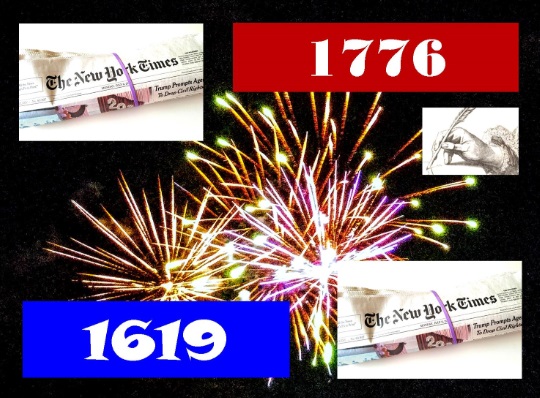
Photo-composition by Thursday Review
The 1619 Project
250 Years Later
| published July 7, 2026 |
By Bob Armstrong
Thursday Review contributor
In 2019 the New York Times discovered 20 enslaved Africans who had arrived by ship in Virginia 400 years earlier made good copy. Americans were finally clued in that, as the paper said, the "true founding" of our country was in 1619, not 1776. The lead editor of the "1619 Project," Nicole Hannah-Jones, declared the main reason the rabble-rousing colonists decided to break away from England was "because they wanted to protect the institution of slavery."
There was some pushback against this historical revisionism, but that didn't stop the Times from turning the 1619 Project into a brand with numerous spinoffs, including podcasts, a book length anthology, children's book, K-12 reading guide, and a six-part documentary.
This past Fourth of July weekend coverage of the semi-quincentennial celebration was slightly less provocative but the Times still flew the woke flag next to the stars and stripes—or maybe above it—with pride. In South Dakota, President Trump "read from an apocalyptic script" with Mount Rushmore in the background. The reporter, Shawn McCreesh, notes Trump "name-checked Karl Marx" and "was not subtle," by pointing out that communism "is the enemy of July 4, 1776." A stretch to say that is apocalyptic since it is true.
The Times' literary critic, A. O. Scott, suggested the slogan "Make America Great Again" is a "powerful counternarrative of loss, decline and betrayal." Both Ronald Reagan in 1980 and Bill Clinton in 1991 campaigned with slight variations on the MAGA slogan but did so as a "shared duty" with the people. When Trump says it we must understand this is nothing more than an "evasion of responsibility."
In the opinion pages actually labeled opinion four rhetorical methods come into play. First up is the standard line from Michelle Cottle that reveals "A core problem—maybe the core problem—with Trumpism in general is that it relies on divisiveness and hate to foster that sense of community." The second method is the snarky line provided by Maureen Dowd who says Trump has "hijacked" the 250th birthday party. She adds the popular progressive belief Trump will somehow remain in the White House past his second term since he plans on keeping the new Air force One plane "when he goes, if he ever goes."
The third method brings in the swinging pendulum, noted by David Wallace-Wells as the "vibe shift" around the time of Trump's 2024 electoral victory. "This was the beginning of an era, we were told; his election was perhaps as significant as the one that heralded the Reagan revolution." But this victory has boomeranged. Over the past 18 months a counter vibe has the "bottom falling out of Mr. Trump's second term and his administration looking again like the same old kakistocracy." Confession: I had to look up that word and it is wonderful. Kakistocracy is the rule of the least suitable, least qualified, and most unscrupulous politicians.
These three lines of opinion—standard, snarky, pendulmish—all help to support the Times' New Foundation line—the 1619 Project. In his opinion piece James Bouie lays down our new understanding of the author of the Declaration of Independence: "It wasn't Jefferson who made 'All men are created equal' actually mean something." That doesn't quite erase Jefferson, although it does put him in his place—a decadent aristocrat relaxing in his armchair at Monticello, a glass of Madeira in his regal hand, perhaps entertaining Sally Hemings, his octoroon honeypot. Meaning in the "Five Words That Changed America" is given to "those outside the circle of belonging: women, Natives, landless laborers and, most starkly, Black Americans, both free and enslaved."
Also outside the circle of belonging are the stories of seven unknown and "unsung actors" in the America's founding profiled in the paper's Sunday magazine section. They are terrific stories beautifully illustrated by the artist Tim McDonagh. While they do indeed give meaning to the American story in the spirit of history from the bottom up, the last 250—or 400+ if you prefer—still has a top. And at the top are Jefferson and the other Founding Fathers.
Bob Armstrong is a journalist and writer, and the author of a new memoir, No Exit From Vietnam, available on Amazon; Armstrong is a frequent contributor to Thursday Review.
Related Thursday Review articles:
250 On The Left; By Bob Armstrong; Thursday Review contributor; June 28, 2026.
Paul Rivera's Midnight Ride: A Closer Look at the DNC's Postmortem; By Bob Armstrong; Thursday Review contributor; June 5, 2026.