
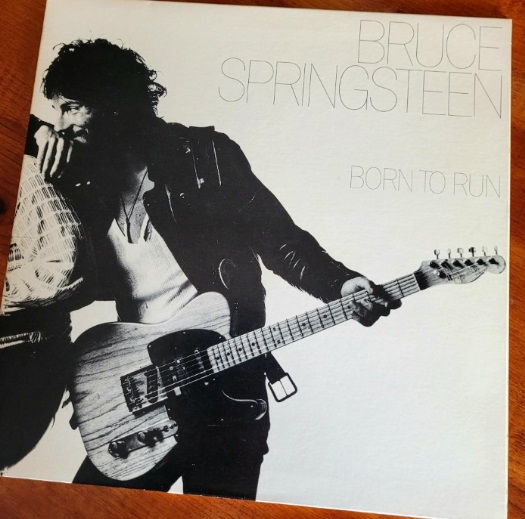
Image courtesy of CBS Records/Photo by Thursday Review
The Runaway American Dream:
A Look Back at
Born to Run
| published January 23, 2026 |
By R. Alan Clanton
Thursday Review editor
The landmark album Born to Run is now 50 years old. It seems a jarring reality, but most everyone who loves rock and roll already knows this fact. Born to Run—not to overstate—was a game-changer for Bruce Springsteen, one of the biggest records of 1975 and arguably one of the most important musical achievements of the 1970s. And even to this day, some 50 years later, it often lands in the top 10 or 20 lists when writers and music critics and editors are asked to name the ten greatest rock and roll albums of all time.
But, Born to Run almost didn’t happen.
At the start of his career, Bruce Springsteen was given two opportunities to get it right. This by an American musical industry in the 1970s where there were few chances even for a second time at bat. If it were not for the lobbying of a few music insiders and a lot of Springsteen loyalists, he and his band would have never been given that third try to break through with a wider public and sell some albums.
Springsteen’s debut album—Greetings From Asbury Park, N.J.—was a dazzling, stunning first outing which generated lots of buzz within the music business and among rock critics, but saw only lukewarm sales. Released in January of 1973, it has the odd distinction of being simultaneously one of the best debut albums ever, as well as one of poorest sellers in its day. It would gain sales traction only years later, well after the huge success of Born to Run; two of its songs would go on to larger fame in the hands of another band when Manfred Mann’s Earth Band recorded their own versions of “Blinded by the Light” and “Spirit in the Night” in 1977.
Still, Greetings received rave reviews from almost every major music magazine, including Rolling Stone, Crawdaddy, and Creem—all of whom praised the originality and freshness of what they heard. Columbia Records’ also spent heavily on targeted ads in magazines with readership thought to be in sync with Springsteen’s musical sensibilities. But record buyers weren’t parting with their cash. Strike one.
Later that same year, Columbia Records and CBS gave Springsteen another try. After a few months in the studio, the result was The Wild, The Innocent & The E Street Shuffle. Again, the music critics fawned and swooned. The album was embraced as another masterpiece of soul-searching originality and craftsmanship, and this time a few of the songs gained a bit of traction among some of the largest FM rock music radio stations—especially in the big northeast markets. But without significant record sales nationally, it looked like Bruce Springsteen might fade away and become a footnote in the rarified niches of folk music and rock & roll. So, strike two.
Indeed, it might have ended there. CBS Records was wary of wasting any more studio time and marketing effort on a project with such limited potential for profits, even if some of their own people were madly in love with this guy’s music. Springsteen’s live nightclub shows were already becoming the stuff of legend, and his core following had become famously loyal. But what use was this to the suits at CBS and Columbia if record sales were limited to three or four states. Besides, CBS had lots of other new talent in the stable (including the up-and-coming Billy Joel).
After some tense back-and-forth, and much heavy-handed lobbying by some of the Springsteen acolytes, both within CBS and from other circles, Columbia threw down the gauntlet, offering Springsteen and his band one more chance to get it right. Columbia at first insisted that Springsteen consider moving his recording efforts to Nashville, where CBS would send in a producer, engineer, and a studio team of their own choosing. But Springsteen—a self-forged perfectionist and obsessive overseer—predictably balked at this. There followed more negotiations.
Bucking the pressure and the odds, producer Mike Appel lobbied hard for a somewhat larger production budget, and for enough time to work on the new songs. But, there would be compromise. For one, to save money, they would use the low-budget venue at 914 Sound Studios, where there would be fewer time constraints. Both Greetings From Asbury Park and The Wild, The Innocent, & The E Street Shuffle had been recorded at 914, so it was familiar ground for Springsteen, through not the more upscale or newer and more sophisticated studios that other CBS talent were able to use. But the trade-off proved crucial: Springsteen and his E Street Band could take their time; but in exchange they would have to create an album with enough mainstream appeal to sell records—and not just in New Jersey, New York City, and Philadelphia. The execs at CBS Records made it clear that they intended to drop Springsteen if this third attempt failed to spark sales.
So, at 914, Springsteen and his bandmates went to work. The sessions proved to be relentless and troublesome for a variety of reasons, not the least of which was Springsteen’s own perfectionism, and the toll this took on everyone as songs were rehearsed and recorded over and over. Adding to the complexity was Springsteen’s own conversion, as it were, to the “wall-of-sound” methodology invented by producer Phil Spector; Springsteen’s first two albums—though energetic and full of life—had been of a breezier, folksier texture, much more akin to early folk rock with an urban vibe. This time Springsteen wanted a more heavily layered sound, and this meant more time in the studio hammering away at each song. The recording also involved more instruments and more time spent overdubbing, a laborious and sometimes difficult process. The album’s eventual title cut, “Born to Run,” took many months to record and mix, and by the time it was completed at least two of Springsteen’s musicians were leaving to go their own way: drummer Earnest Carter and pianist David Sancious departed the E Street Band and created their own jazz band called Tone. Springsteen replaced them with Roy Bittan and Max Weinberg, who would both remain with Springsteen for decades.
Born to Run also generated many false starts, do-overs, and out-takes. Its cohesive eight-song line-up saw a dozen other songs flow in, then, eventually out of the running. A prolific songwriter, Springsteen was also constantly re-writing the existing material, which could lead to frustration among the other musicians. This is one area where new members Bittan and Weinberg helped to improve morale, as their easy-going personalities and professionalism helped usher-in a more disciplined and unified approach to the challenge ahead. But still, the overall effort of creating a new album was languishing, and their time had almost run out at 914. And, for all the band’s work, only one song—“Born to Run”—was fully recorded and in satisfactory condition. But worried that CBS might yet boot the entire project, producer Mike Appel devised a risky and largely unethical tact, sending copies of the song “Born to Run” to numerous radio stations without the approval of anyone at CBS or Columbia. Though he was soon admonished for this ploy, the sudden burst of radio airplay by the stations gave Springsteen and Appel leverage, and this traction eventually allowed a reluctant CBS to allow for more money and more time to complete an album.
By March, the band moved from 914 to the more prestigious and better-equipped Record Plant in Manhattan. Impressed by the sound of the one song he had heard, Jon Landau—who had met Springsteen previously and written about the first two albums—joined the project as co-producer, along with producer and engineer Jimmy Iovine. Then, only about a month into the new studio venue, Steven Van Zandt—who had known Springsteen from a previous band called Steel Mill—joined in the sessions, adding a more aggressive guitar and helping to arrange the other instruments into to overall concept as additional studio musicians were brought in to add layers of sound, including horns and strings. Still under pressure to complete an entire album by their revised deadline, another grueling round of mixing took place. In the meantime, Springsteen and Landau were still trying to decide which songs to keep, and which to toss. The eventual decision centered on keeping the musical themes consistent with the overall package. In all, according to some sources, as many as ten songs were kicked off of Born to Run to make way for the eight songs which became the final album. (A few of these recordings were released in 1998, and two more lost tracks appeared in 2004.).
In the end, the eight songs that make up Born to Run seem as if they belong naturally, organically on the album, though clearly this was the result of a complex collaboration between the principal creative parties, including Springsteen, Appel, Landau, and the newly-added Van Zandt. This eventual melding wrought what very quickly became a classic album, even as a weird convergence of media factors spawned a firestorm within the larger picture of a new album by a musician finally receiving his due sales traction.
On Monday, October 27, 1975, Bruce Springsteen was featured on the cover of both Time and Newsweek—the first time a non-political, non-military person had been displayed on both magazines at the same time. It was, in fact, a bizarre coincidence, and though there had been back office rumors within music journalism that each magazine might be looking into Springsteen as a subject of articles, there was no planning or coordination. The side-by-side appearance that Monday of the two newsmagazines came as much as a shock to both sets of editors as it did to a public suddenly confronted with what appeared to be rockstar overload.
In fact, each magazine approached the story from separate angles, with Newsweek’s tack generally negative—exploring what the writers considered manipulation and over-packaging by the a music business intent on manufacturing a star and deploring the heavy-handed promotions by CBS and Columbia. To a degree, this was true enough: CBS was determined to see the Born to Run project through to some form of success after investing so much time and cost into Springsteen’s first two albums, each of which had been adored by critics but had been largely passed over by record-buyers.
Time magazine plunged headlong in the other direction, with film and music writer Jay Cocks examining Springsteen as a new, dynamic, rapturous voice of his generation, forging a rock and roll infused folk music which spoke to disenfranchised young people (young, in the context of Born to Run, not necessarily “teenage” young as so often defined by, say, The Beatles) across the urban and suburban swath of America already being called the Rust Belt. Born to Run was evocative, atmospheric, and strongly visual. This analysis, too, was largely on the mark, though its broad overstatement implied that Springsteen was the Elvis or Dylan of his era (to a degree, and in the ensuing wave, this too became self-fulfilling).
Predictably, the timing of Springsteen’s appearance on both magazines covers generated an official journalistic backlash, with some newspaper and magazine writers and editors slamming rock music generally, and Springsteen and CBS specifically, for what amounted to a marketing scam—over-cooked hype surrounding a musical artist who happened to have the right sorts of friends deep within the New York music scene. Never mind that Springsteen had already established a hard-core base among those who followed him in small performances in the northeast, or the already established traction of radio airplay in several large markets.
Still, the song “Born to Run” had finally gained enough popularity in other parts of the country to pull the album into the spotlight, whether the October surprise of Newsweek and Time had happened or not. The extreme amplification of two major newsmagazines briefly damaged Springsteen’s credibility as much as it helped, but in the end the music on Born to Run prevailed in very short order. Furthermore, even before the editorial backlash had died down, a bevy of other music critics had entered the fray to sings the praises of the music they were now hearing.
The album was largely considered both visionary and universal, and clearly the lyrics and music spoke to this voice: though written with an ostensibly “urban” vibe and scenery, the music also spoke to the heartland and the world beyond the suburbs, with an easy embrace of all that rock music and “folk rock” had become. It was also aggressively new, even though its DNA could so easily be traced to the words and stories of Bob Dylan, the musical complexities of Three Dog Night, the direct, approachable storytelling of Arlo Guthrie, and the passionate vocal style of Joe Cocker. If the words explicitly told the story, say, of events along the Jersey Shore, the music and storytelling spoke just as easily to listeners in Macon, Georgia, or Skokie, Illinois, or Reading, Pennsylvania.
And the youth aspect of rock and roll had of course come full circle: Springsteen was speaking to a generation which included lots of people already in fear of growing old—a post-Vietnam, post-Watergate, post-Peace-Movement age in which empowerment often competed very closely with unemployment, and in which younger people in their twenties and even into their thirties sought escape from economic cycles and cultural entrapment. Incorporated into this were the tools of the young American Dreamer: the muscle car, and the open highway out of town, and the guitar, which offered salvation for anyone willing to become proficient. The songs on Born to Run offer poetic paeans to these vehicles, often in undisguised form. In addition to the title cut, which is the first song on Side Two, the songs “Jungleland,” “Backstreets,” and “Thunder Road” each tell cinematic variations on these same cultural themes, the same restlessness, and similar modes of escape.
The album Born to Run was released in late August of 1975 and its traction began steadily and ramped up as the songs caught the attention of more radio stations. That the album produced only two singles—“Born to Run” and “Tenth Avenue Freeze-Out”—belies the fact that nearly every song on the album got significant airplay within the first 18 months. Aside from the two singles, two other standouts songs faired almost as well on FM album oriented stations and college radio stations across the U.S.—“Thunder Road” and “Jungleland.” Such was the success of the album that the execs at CBS saw no reason to trifle with more “singles” when the album itself had so quickly become a top seller..
More than a few critics noted that one of the attractions of Born to Run is that it represented a paradigm shift, a critical moment when a large part of rock and roll rebooted. Like The Beatles’ Rubber Soul, The Beach Boys’ Pet Sounds, and Bob Dylan’s Blonde on Blonde, Springsteen had forced a significant recalibration of how rock should feel and sound, paving the way for other “operatic” approaches to rock and roll, other forms of working class poetry, and what became known as “heartland rock”: Meat Loaf’s Bat Out of Hell (a monumental classic of the form); Jackson Browne, Bruce Hornsby, John Mellencamp, Tom Petty and the Heartbreakers, Southside Johnny & The Asbury Dukes.
Born to Run is also an album-lover’s album—most readily enjoyed (especially by Springsteen fans) when listened to from start-to-finish, as a package deal, starting with the gentle, almost subdued opening piano notes and vocals of “Thunder Road” and ending with the grand, operatic final notes of “Jungleland.”
The album benefitted mightily from the ideal chemistry. By the time recording had concluded in 1975, Springsteen’s studio and on-stage line-up had finally gelled. Moving forward, the E Street Band had a core of highly talented musicians intensely loyal to Springsteen and his vision, and they proved irrepressible when it came to live performance. Though both Sancious and Carter had exited midway through the recording, they had been replaced by Roy Bittan and Max Weinberg respectively. Danny Federici (organ, keyboards) and Garry Tallent (bass guitar) rounded out the line-up, and Clarence Clemons and his saxophone had been made a permanent member of the team. Van Zandt had worked with Springsteen before, and his permanent addition put the final piece of the puzzle in place. Indeed, it became difficult to imagine the live stage line-up without Clemons’ looming, iconic presence and Van Zandt’s energetic and joyous guitar work (I saw the entire band perform live twice, once in 1981 and again in 1984, and Van Zandt and Clemons added as much to the power and energy of the show as Springsteen himself).
One residual effect of Born to Run: sales of Springsteen’s first two albums began to grow, spiking significantly as the huge influx of “new” fans suddenly discovered the Springsteen albums from 1973. This also had the effect of boosting the credibility of those performers who had covered Springsteen’s previous work (Manfred Mann’s two famously borrowed songs, for example), and connecting the dots back to Springsteen’s clear lineage to the works of Bob Dylan and others—including Springsteen’s own guitar heroes like Elvis Presley, Chuck Berry, and Buddy Holly.
Born to Run is a classic of American rock and roll, clearly Springsteen’s masterpiece (he recorded many other very good albums, among them Darkness on the Edge of Town (1978), Born in the USA (1984), Nebraska, and The Rising), but also arguably one of the most important albums in rock history. In 1987, Rolling Stone magazine ranked it number 8 on its list of the “100 Best Albums of All Time,” and even by 2003 it had dropped to only 18th on the same Rolling Stone list—still a substantial place in the Pantheon of great records.
Like the other trailblazing albums before it—The Beatles two most pivotal records, Rubber Soul and Revolver; Bob Dylan’s Blonde on Blonde; Chicago’s debut Chicago Transit Authority; Led Zeppelin’s debut record—Springsteen had melded and fused a variety of musical and lyrical forms to press a particular kind of rock and roll out of its mold. Born to Run remains a seamless fusion of folk rock and hard rock, infused with both city and heartland themes, and melding urban poetry with some of those great American dreams: the car, the open highway, and the kind of redemption found through the guitar.
Related Thursday Review articles:
A Splendid Time is Guaranteed For All: Sgt. Pepper at 50; Kevin Robbie and Alan Clanton; Thursday Review; June 14, 2017.
The American Working Man's Rock & Roll: Greetings From Asbury Park, N.J. 40 Years Later; R. Alan Clanton; Thursday Review; July 4, 2013.