
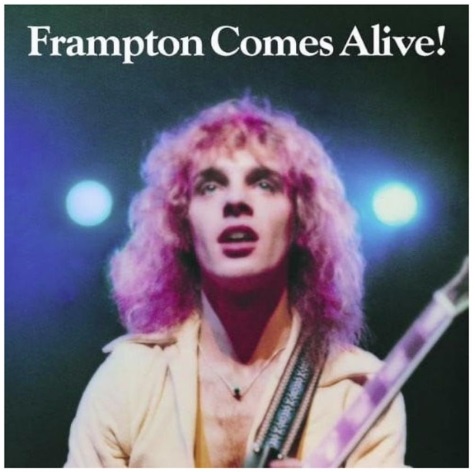
Courtesy of A&M Records
Fifty Years After
Frampton Comes Alive
| published April 9, 2026 |
By R. Alan Clanton
Thursday Review editor
Live albums can be a dicey business for any musical artist. Advances in recording technology and even more striking advances in the acoustic design of newer venues has helped some over the decades, but it has not vastly improved the proposition that recording rock music in arenas, concert halls, and especially stadiums can be fraught with challenges and complexities.
Live rock records are also prone to costly misunderstandings and technical foul-ups, including the all-important audience participation needed to give the music its ambience and its energy.
Even bands as proficient musically on stage as Rush—to name but one example—can endure misfires over the decades when it comes to how their music sounds when recorded live. Other bands nail it quite well, though much can be done in the digital age of processing to improve the final product. Green Day’s Awesome as F**K serves as an example of how to do it right, though Green Day received some askance reviews indicating that much of what listeners heard had been evoked by technology and computer wizardry within the digital studio.
Some of the greatest live rock records made their way to prominence in the 1970s, and a few of those came from bands otherwise struggling to that point. Cheap Trick’s At Budokan—recorded in 1978 in Osaka, Japan—remains one of the best live albums ever recorded, and serves as an example of how a band can emerge from relative obscurity on the merits of a dazzling performance in front of the right crowd.
But there are few 1970s classics quite as striking or legendary as Peter Frampton’s Frampton Comes Alive.
The young British guitar prodigy Peter Frampton had proven his chops in several great rock bands earlier in his career, most notably six years (and five albums) with Humble Pie. He was also a proficient studio musician, and had spent significant time working alongside other British and American rockers, including Billy Preston and Ringo Starr. Launching out on his own in 1971, he recorded Wind of Change in 1972. Then, in 1973, came Frampton’s Camel. Neither of the albums sold particularly well, though a few of the songs caught the attention of the growing FM album oriented radio audiences in the United States, and Frampton himself grabbed the talk of rock music aficionados much in the same way that Bruce Springsteen had developed a loyal following prior to his striking gold with Born To Run.
More album work was completed—including 1974’s Somethin’s Happening—and Frampton continued to collaborate with other rock musicians, including Keith Moon, David Bowie, and John Entwistle. Still his albums were languishing, and he faced the significant risk that his solo career might auger-in (though he clearly could have easily continued his frequent collaborations).
Then came the dazzling live album. Recorded between the early summer of 1975 and November that same year, Frampton Comes Alive began to take shape across multiple venues: the Winterland Ballroom in San Francisco; Marin Veteran’s Memorial Coliseum in San Rafael; the Long Island Arena in Commack, New York; and a college campus appearance at the State University of New York, at the Plattsburg campus.
There were some challenges even with these four venues for recording, including engineering issues with microphones placed in the wrong locations, cords accidentally disconnected, and other common live show mishaps. Still, all four appearances went well, and Frampton and his team were able to fix the only problems by simply recording brief retakes in the studio. Oddly, despite all intentions to release the album as a traditional vinyl album with an A and B side, the execs at A&M bought into the idea of making the whole package a double album—a decision based mostly on the length of some of the songs, as well as what they perceived was the high quality of what they heard. Normally averse to songs exceeding about 5 minutes on radio, the team at A&M decided to let the album roll out as long as there were a few options for radio (these would include “Show Me the Way” and “Baby, I Love Your Way,” which had each been singles on his previous albums.
For those who slept through the 1970s—or, more likely—were not yet born, Frampton Comes Alive became the surprise album of 1976. Released on January 15, 1976 in the United State, it would debut on the Billboard 200 album chart at 191—modest but near the end of the list. But it gained its traction very quickly. The album’s dazzling appeal comes from the striking combination of guitar virtuosity by Frampton, musical tautness by the rest of his band on those stages (especially the keyboards and drums), and impressive recording quality (despite those few glitches). And when one adds the visceral energy provided by the audiences (in all four locations), the music seems to rise to the occasion in ways that very few lives albums are able to.
The combination of all these elements fast-tracked the album in every way, allowing it to dominate album-oriented FM radio stations in the U.S., and making instant live classics of several of Frampton’s previous singles. To deflect concern about the cost of the double album, after some complex confabulation internally, A&M also made the deliberate (and wise) decision to release the record at a price much closer to the traditional single disc recommended list price of $6.98 in the U.S., indeed only $1.00 more. At $7.98, few young record buyers would be put off by the price, and many would consider the extra dollar to be a bargain. A similar arrangement was settled for the album with its release in the U.K. only weeks later.
From its starting point at 197 out of 200 on the Billboard charts, Frampton Comes Alive quickly climbed. By April of 1976 the live album had reached number one; it crisscrossed back and forth on the charts, but managed that year to gain the number one slot ten times before October. And remarkably, it managed to surpass many other classic albums from that year to end up as the number one selling album in the United States, beating out The Eagles’ Hotel California, Boston’s debut album Boston, James Taylor’s Greatest Hits, and Wings at the Speed of Sound.
Further, in an usual metric, Frampton beat out The Beatles: Frampton’s long-form song “Do You Feel Like We Do,” which comes in at a staggering 14 minutes on the live album, was edited down to 7 minutes 19 seconds for radio airplay for Top 40 stations, meaning it effectively broke the previous mainstream long song, "Hey Jude," which was until that date the longest single released by The Beatles or anyone else for that matter.
Like most great live albums, Frampton Comes Alive is a package deal—best enjoyed from start to finish, which can be more easily managed of course in the age of the CD. Frampton Comes Alive was one of those party favorites, and di rigueur for those who loved vinyl in its heyday, and for those who collect it now.
For younger readers of Thursday Review, give this album a long and thorough listen: this is the majesty of the rock guitar at its 1970s apogee, and there are few live albums as powerful as this record. Also, listen to it loud. In 2012, Rolling Stone readers voted it the 3rd greatest live rock record of all time. To date, Frampton Comes Alive has sold more than 8 million copies worldwide.
Related Thursday Review articles:
The Runaway American Dream: A Look Back at Born to Run; R. Alan Clanton; Thursday Review; January 23, 2026.
Dire Straits Brothers in Arms 40th Anniversary; By R. Alan Clanton, Thursday Review editor; November 1, 2015.