
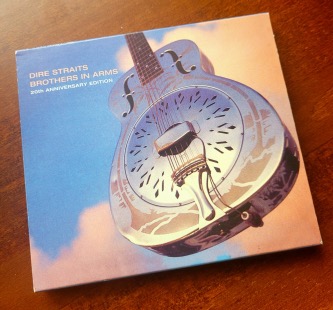
Image courtesy of Warner Brothers Records
Dire Straits, Brothers in Arms: 40th Anniversary
| published September 6, 2025 |
By R. Alan Clanton Thursday Review editor
In December 1985 Thursday Review compiled and published its list of the best rock albums from that year, a short composite list made up of the top five choices of six of our writers and contributors, and Brothers in Arms, the landmark album by Dire Straits, topped the list. It wasn’t even close..
1985 had been a good year for rock and roll overall, and at what one might term Phase One of the Post New Wave/Post Punk era, the musical offerings for the previous 12 months had been remarkable: Phil Collins, No Jacket Required; Eurythmics, Be Yourself Tonight; Prince & The Revolution, Around the World in a Day; John Mellencamp, Scarecrow; R.E.M., Fables of the Reconstruction. 1985 also saw Talking Heads release Little Creatures, a remarkable work in itself and the only other album which got three votes from among our editors and writers. Albums by Tom Waits, Robert Palmer, INXS, and John Fogerty (for his classic Centerfield) all got at least one vote.
But Dire Straits almost swept the vote, with Brothers in Arms receiving at least one vote from five of our six panelists, and placing number one on two of the short lists (Earl Perkins and Alan Clanton) and second on the list from contributor Kathy Weatherby. The modest TR music critic gang was not alone. Brothers in Arms became a huge critical success that year (and well into the next), and is now widely considered a landmark musical achievement.
The commercial success of Brothers in Arms is a small piece of this album’s legacy, but those sales deserve some attention right away any retrospective look at this dazzling achievement. Among other notable firsts, the album became the first to sell one million units in CD form, and some have argued helped accelerate the widespread acceptance of the still relatively new (and sometimes expensive) format which was thought might replace vinyl records and analog tapes. (Some personal trivia: I bought Brothers in Arms in vinyl form first, and later, after I finally purchased my first CD player and added it to my sound system, added the same in compact disc; however, it was my second personal CD purchase, the first being, of course, Abbey Road).
Released by Warner Brothers in mid-May 1985, Brothers in Arms followed closely on the critical success, stylistic elements, and the robust sales of the band’s 1980 album, Making Movies, which featured “Tunnel of Love,” “Skateaway,” and “Romeo and Juliet,” as well as the 1982 album Love Over Gold, which had also generated lots of radio airplay with the songs “Industrial Disease” and “Private Investigations.” Both albums had established the band—and in particular the works of front man guitarist-songwriter Mark Knopfler—with a solid footing in both the mainstream and progressive arenas, while still maintaining a strong musical connection to the loosely and oft-ill-defined New Wave. The songs from the previous two albums received lots of radio airplay across the musical formats of Top 40 and harder rock stations.
But for most fans, Brothers in Arms immediately felt different almost from the first hearing. Among its notable features was the coherence of the total musical package—a fidelity to the concept of the album as art form and the need for all songs to have strength and relevance. Even in the 1980s there were still musical artists and bands who opted for the easy path, which is to say a couple of good songs (at least one, possibly two Top 40 hits), spaced apart by 6-to-7 throwaway tunes to fill the record. The powerful tsunami that defined the New Wave and the Punk Lite movements helped encourage this business model: one song might be enough, and if the band was lucky, two would help.
From 1979 to about 1986, the list of one-hit-wonders nearly defines the era, and even those bands with multiple hits during that stanch of time are still remembered for the very narrow niche they occupied. The Knack; The Cretones; The Romantics; The B52s; Devo; The Go Gos. Even now, for those of a certain generation, these bands’ most famous songs trigger powerful cultural strobes and fragrant atmospherics. Who can listen to “Take On Me” by a-Ha without a surge of joy? Who can listen to “What I Like About You” by the Romantics and not feel the urge to dance?
Still, Knopfler’s Dire Straits wanted little to do with this model. Brothers in Arms shares a powerful element in it musical DNA which connects it to what is arguably the first cohesive and coherent total album, Rubber Soul, the 1965 recording by The Beatles—an album which literally redefined pop and rock music, and which became the crucial pivot point for the fab four, ushering them (and almost all of rock and roll with it) into a brave new age of album-oriented rock music. It is coincidental but still notable that Brothers in Arms was released twenty years after Rubber Soul, cementing two full decades of rock and roll as heard and appreciated through the long form of the album, not as simply the work of an artist able—every year or so—to pop out a great tune. After Rubber Soul in 1965, sales of 45 rpm records—which typically had one hit on the A side and a more-or-less throwaway song on side B—began a slow but inevitable decline. Bands and performers as diverse as the Rolling Stones, Bob Dylan, Cream, Country Joe & The Fish, and the Beach Boys all faced the new creative reality (and all acknowledge that Rubber Soul had stamped that reckoning upon British and American pop) that the album was king, not the intermittent single.
Brothers in Arms is a package deal, and those who were at first dazzled by one or two of its most notable singles—“So Far Away” or “Walk of Life,” to name a couple of examples—found even more reason to be awestruck upon listening to the album from start-to-finish, forty-seven minutes of the sort of aural cinema which Knopfler and his bandmates surely intended fans to experience. This cohesive sound—which in large part explains why the nine song package has grown stronger with time, and so steadfastly kept the album from sliding into a dustbin of partially forgotten 80s theme songs and period pieces—has helped keep the album on the “best of” lists of scores of magazines and published retrospectives.
Oddly, Brothers in Arms did not at first generate much positive critical notice. Many British reviewers shrugged it off as passable but uninteresting, with still others in the U.K. press scoffing at the album’s stark similarity to the two previous records. Also, some British critics actually grimaced at the album’s self-conscious identity as a package deal, complaining mildly that Knopfler seemed determined to center the band’s music squarely in the best seating in the “album-oriented” ballroom. The U.S. press liked it more, and some on both sides of the Atlantic acknowledged the album’s technical proficiency; it was a given that some music critics in those day would slip into the same paradox—the somewhat circular reasoning that if the music sounded really good, there must be something inherently wrong about how it was created. Think of bands as diverse as Boston (its first album) and U2 (The Joshua Tree), who had to fend off criticism that the engineering and production values were so effective as to render the music suspect. Put another way: good craftsmanship in the studio must equal some form of sell-out, or at least that was the theory.
In part this critique regarding the record’s crystalline quality was well-founded in its basic form: Brothers in Arms was in fact about as state-of-the-art as an album could get. Among other factors, it was the first complete album to be recorded using a 24-track fully digital recording system. The album was also consciously recorded and produced to be a full-throttle exploration of what could be achieved on the relatively new format of the CD, with its vinyl and cassette versions secondary to the tech processes and even to sales objectives. Like Rubber Soul twenty years before, this proved pivotal: after its release, sales of Brothers in Arms became so robust that it actually hampered the ability of other musicians and performers to get the stuff available on CDs (more about that later).
Knopfler and co-producer Neil Dorfsman also used the best and newest equipment they could find, save for the Neve 8078 mixing console, which dated from the late 1970s but was widely respected by many musicians for its high caliber. Knopfler and Dorfsman also did everything within reason to sweeten the sound, despite being in the relatively cramped studio of the already aging but beloved AIR Studios in Montserrat, where The Police had recorded Ghost in the Machine, and where bands as diverse as Earth, Wind & Fire, Rush and Black Sabbath had worked. By the time Dire Straits got into the studio in Montserrat, new members Guy Fletcher and Jack Sonni has become fully integrated into the band’s line-up and sound.
But even with the cutting-edge digital recording methods and Knopfler’s passion for technical proficiency, the recording was not without challenges. A batch of defective digital tape lowered the quality of some songs, and forced other songs to require later re-recording some elements in New York. There were problems, too, with the drums, both technical and personal, as Terry Williams was never fully satisfied with his performance or any of the tracks. Williams later complained that he had worked with a rhythm synthesizer in his ear, which was meant to manage his tempo on each song; but he considered this more of a hindrance than a useful tool, since it impacted his ability to flex and flow organically alongside the other sounds and instruments. He was replaced in the studio briefly by Omar Hakim, though Williams would remain officially in the band and would appear on stage and in all subsequent music videos from the album. Williams’ studio drums can also be heard in the long jazzy percussion and synthesizer run-up at the start of “Money for Nothing.”
The studio was also crowded. Newer, more complex equipment had been brought in, but the room—little more than an average Florida room or small den—offered scant wiggle room for a band with multiple keyboards and a raft of speakers and electronic gear. Dorfsman and engineer Steve Jackson made the best of the situation by using other rooms in the building and getting creative with the placement of instruments and speakers. By the time Dire Straits had arrived in Montserrat, the space in AIR Studios was already undersized for most rock bands, but the Neve mixing console was still the jewel. More studio and mixing work was done in New York City in February and March, and recording was completed at the end of March.
On April 12 in the U.K. and in Europe the song “So Far Away” was released. The song was also released in the U.S. only weeks before the album itself. On April 25, starting with shows in Yugoslavia and other Eastern European venues, the band began what was arguably one of the most ambitious—and ultimately grueling—lives tours ever attempted by a major group—nearly 250 shows spread out over a one year period, in 23 countries, with one of the tour’s highlights an unprecedented 14 shows at Wembley Arena outside London in July 1985 (this two-week run included a performance at Live Aid, in the adjacent Wembley Stadium, on July 13 with Sting added to the vocals on the stage).
Released in May 1985, the record launched itself into a popular music culture enamored with MTV and the music video, a conceptual form which was hitting its stride with such force that it nearly upended the process of musical composition. Songs were not simply songs, but narratives against and around which one could (and would) create an entire visual story, often with visuals of the performers and the band members juxtaposed onto the parallel images of the “song” and its tales, trials, tribulations. The subculture of video rock and roll became the tail that wagged the dog, at least in many instances. But the videos turned inward and toward irony and sarcasm with stunning speed.
“Money for Nothing,” arguably one of the most famous of the album’s tunes (and a soon-to-be huge hit in the U.S. and the U.K.), links itself directly with the cultural phenomenon of the music video. The video itself was groundbreaking—an early use of sophisticated computer animation to create 3D-like characters moving about in a similarly 3D environment. In the video, two guys working in a large appliance store take time out of their blue-collar day to catch a few minutes of “videos” on the multiple TVs in their retail store. The men both mock and admire the music videos they see (“Ah, that ain’t workin…that’s the way you do it…you play the guitar on the MTV!”). Though by today’s standards the video seems primitive, at the time it was as cutting edge as computer generated animation could get, combining a Quantel Paintbox system with a Bosch FGS computer, along with many hours of processing time. Depending on the point of view of the reviewers, this was either boldly fortuitous or conspicuously manipulative—a state-of-the-art computer video about two guys admiring music videos, all to the sounds of a song recorded using what was in 1985 some of the best technical tools in the musical producer’s toolbox. The voice of Sting can be heard at various points throughout the song, but most notably in the long, repetitive detumescence as the song unwinds, his voice softly calling out “I want my MTV” in a melody remarkably similar to his “don’t stand so close to me” refrain from the Police song of the same name (there was a minor legal kerfuffle over this bit of borrowing).
That some music critics at the time were nonplused by the linkage is ironic also; Knopfler himself did not like the idea of any music video which did not simply show him and the band performing the song. But the suits as MTV (a few wore actual suits in those days) so loved the idea of poking fun at their money-making world that they insisted on personal meetings with Knopfler and other band members to make the case. In the end, Knopfler never fully agreed, but after a few shrugs, and no clear-cut veto, the video got released anyway. Within weeks, the “video” became almost as popular as the song. The video’s popularity also helped usher forward the next few steps in computer technology, especially those evolving tools to generated the quasi-3D type animations that would be largely taken for granted within a decade. It is interesting to note how quickly special effects and digital effects advanced in the mere six years between “Money for Nothing,” and the 1991 release of Terminator 2, and the 1995 release of Pixar’s Toy Story.
And once again, there was a first: where the Buggles’ song “Video Killed the Radio Star” had been the first music video to be shown on MTV, “Money for Nothing” was the first to be shown on British MTV—another point not lost on some critics at the time, but in fact a poetic and perhaps fitting debut when MTV’s popularity took it to cable television in the U.K.
Brothers in Arms was Dire Straits’ fifth album. The band was already a nightclub and “pub band” sensation by the middle 1970s, and after a few rejections of their demo tapes, they were given the chance to record their first album in London in 1978. At that time the band consisted of Pick Withers, John Illsley, and brothers Mark Knopfler and David Knopfler. Shortly after the release of their first album, the group established its bona fides when the song “Sultans of Swing” first hit the radio across the U.K. and the U.S. Despite a few personnel changes—notably the departure of Mark’s brother David during the 1980 recording sessions for Making Movies—the signature sound of Dire Straits took shape, and took hold among the band’s growing fan base. Each album featured ever more complex arrangements, and each album also sharpened the distinctive sounds and rhythms even as the music grew more diverse.
Indeed, that diversity of tempo and style found on Brothers in Arms—up-tempo fast rock mixed with joyful pop interspersed with the soulful ballads (many of these quieter sadder tunes on Side 2)—paradoxically brings the album into focus and cohesion as something very close to a concept album. Again, one is drawn to look at other fully integrated rock albums as having ancestral connection to Brothers in Arms: The Beatles’ Rubber Soul; Led Zeppelin’s Fourth Album; Bruce Springsteen’s Born to Run; Fleetwood Mac’s Rumours.
Written and produced as it was in the early 1980s—much of it against the backdrops of both U.S. and Soviet intervention in proxy fights throughout the world and the Britain’s war with Argentina over control of The Falklands, much of the album (indeed almost all of Side 2) takes on a decidedly anti-war-anti-violence theme, though in truth the lyrics circumvent bluntness and provocation through a skillful, poetic timelessness. The music, even as one reads the lyrics, avoids the clichés of the era and transcends the familiar political schmaltz that so frequently clings to the music of stridency or preaching. The softer, mournful mood of the songs leading us to the album’s finale—“Brothers in Arms”—seem at peace in this natural place in the symphony as a whole.
This too, helps to sweeten the album’s overall cohesion. It is very difficult to listen to Brothers in Arms as anything less than a package listening session—allow yourself a full hour, put on your headphones, and listen to the songs from start-to-finish, the way one might listen to an early Yes album. The music and the words seem far more universal when taken as a whole, and this may largely explain why the album seemed so underrated at the time of its release, and why it resonated so deeply with music fans around the world. It’s three biggest hits—“So Far Away,” “Money for Nothing,” and “Walk of Life”—still feel vivid and fresh despite decades of radio airplay, and that says a lot about the much of the lesser music of the mid-1980s, but like Who’s Next or Deep Purple’s Machine Head, the full album transcends even the best of the individual songs. Or, within the 1980s context, U2’s The Joshua Tree, another album for which the whole outweighs the sum of the parts.
Over time, Brothers in Arms has grown in stature. This is a measure we often use to establish the true importance of great art and cultural phenomena over the decades. Indeed, it is one of the standards we use here at Thursday Review: does a movie, or album, or book grow in strength and power with time, or does it seem threadbare or dated or—worse—a whim of the times when we go back to it. As an album, Brothers in Arms improves with time, and even forty years later still seems both relevant and vivid in its freshness. And, like Rubber Soul or The Joshua Tree, Brothers in Arms has no throwaway songs. Even those most diehard of rockers and pop aficionados can’t shunt aside the more mournful tunes or the ballads. Perhaps more fittingly, even those who musically came of age in the long creative expansion that was the late 1970s and all of the 1980s, Brothers in Arms endures precisely because it does not easily lend itself to easy period-piece shelving. It is arguably one of the best albums to emerge from that decade, and a shimmering example of capturing lightning in that bottle of musical time.
In May of 2025, the album was repackaged and rereleased for the 40th anniversary, in this instance as a triple album on CD (and a 5-LP boxes set on vinyl for the true believers with extra money to spend), special collections which include full-length recordings of concerts and additional studio recordings as well.
Related Thursday Review articles:
A Splendid Time is Guaranteed For All: Sgt. Pepper at 50; Kevin Robbie and Alan Clanton; Thursday Review; June 14, 2017.
The Cars: A Look at Their Debut 40 Years Later; R. Alan Clanton; Thursday Review; August 3, 2018.